.jpg)
A Working Hypothesis on the Market Research Ecosystem
Our understanding of who buys, who produces, and who consumes market research is still evolving. Here we share our current hypothesis: a triangle of ecosystem roles that keeps the loop running—and why that shapes how we think about our ideal customers.
At Moncho we observe how market intelligence is commissioned, produced, and used. Over time we have noticed a pattern that holds across many markets: the buyer, the producer, and the consumer of research are often different actors. This post captures our current hypothesis—not a fixed conclusion. We expect to refine it as we learn more from customers and from the ecosystem.
Three Roles in the Loop
In many contexts, large institutions commission and pay for research. Analysts and consultancies produce it. SMEs and startups often consume insights more than they directly fund studies. That does not mean startups do not need research—it means their decision culture and budget often lead them to use research as validation after the fact rather than as strategic input before the bet. The real, repeat buyers of market research tend to be entities that must justify decisions with evidence: development agencies, trade bodies, consulting firms, and large corporates.
We find it useful to picture the ecosystem as a triangle with direction. Each corner is a role; the sides show how value and learning flow.
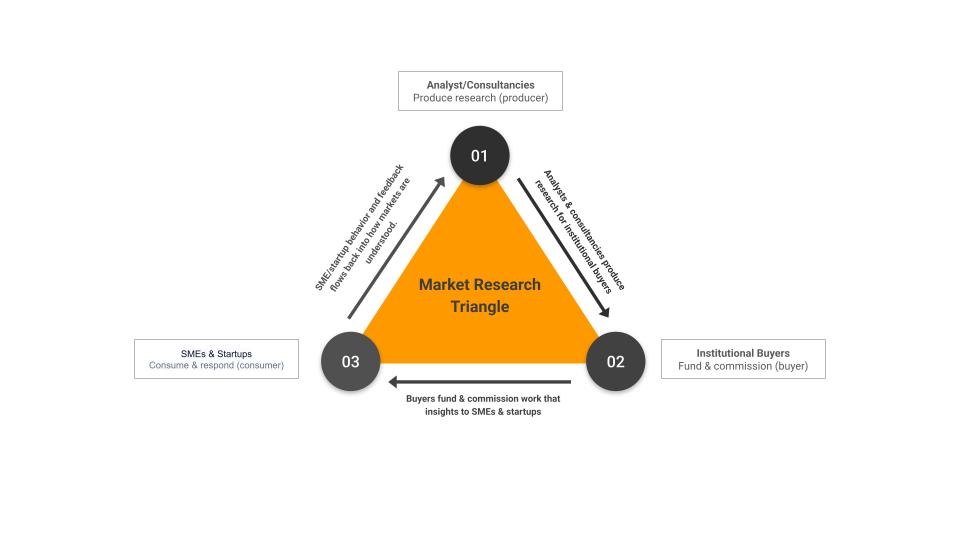
What each corner represents
We use three ecosystem roles to describe the loop: buyer, producer, and consumer. They map to the corners of the triangle as follows.
- Institutional Buyers (buyer): VCs, conglomerates, large companies, trade bodies, development programs. They commission research and have budgets; they must justify decisions with evidence.
- Analysts & Consultancies (producer): Research firms, consultants, analysts. They produce market studies, sector reports, and strategy deliverables. Their biggest pain is analyst time; infrastructure that reduces research effort matters to them.
- SMEs & Startups (consumer): Insight consumers and occasional buyers. They use research to validate or contextualize—but often do not derisk decisions through research first. They are important for distribution and product feedback, not necessarily as the primary paying customer.
Why This Distinction Matters
If we treated everyone who consumes research as if they were also the payer, we would misallocate focus. Our ideal customer profiles (ICPs) are the accounts most likely to pay repeatedly: consulting firms, development programs, institutional research buyers. Personas—analyst, consultant, founder, investor—describe who uses the product day to day. Ecosystem roles—buyer, producer, consumer—describe how the market works. A market can have three essential roles without our having three equal ICPs.
This framing is consistent with how other service ecosystems work. In education, teachers deliver the service, parents pay, and students consume—three roles, one loop. In market research, institutions buy, analysts produce, and startups/SMEs consume. Without any one role, the loop weakens; but the commercial priority for a product like Moncho is the buyer and the producer, not the consumer alone.
What We Are Building
We are building market intelligence infrastructure, not one-off reports. The initial buyer is often the institution or the consulting firm. The day-to-day user may be the analyst. The downstream beneficiary may be the founder or the operator. This is our current framing, subject to refinement as more customer evidence comes in.
Further reading
For how we translate this into who we serve and prioritize commercially, see Who is Moncho For? Understanding Our Ideal Customers.
Market intelligence on Moncho is reviewed by Moncho analysts before publication.